Barcelona in 24 Hours: Quick Route
Best for: First-time visitors, architecture, history and independent exploration
Tour style: Self-guided
Book ahead: Park Güell and Sagrada Família
Start: Gràcia / Park Güell
Finish: Barceloneta or El Born
8:00 AM — Start Slowly in Gràcia
Resist the urge to begin your day at Barcelona's busiest square.
Instead, have breakfast around Gràcia, north of the city center. Starting here puts you close to Park Güell and means the rest of the day's route generally moves downhill and toward the sea.
Keep breakfast simple. You have plenty of opportunities to stop later, and one of the advantages of exploring without a guide is that you don't need to plan every coffee break in advance.
From Gràcia, make your way toward Park Güell for your timed entrance.
9:30 AM — Explore Park Güell
Park Güell is a useful place to start because it introduces one of the visual ideas you'll keep encountering throughout the day: Gaudí rarely treated architecture as something separate from nature.
Look beyond the famous mosaic-covered bench.
Notice the stone columns beneath the elevated paths, the irregular shapes of the structures, the views over Barcelona, and the way the architecture seems to emerge from the hillside rather than simply sitting on it.
At the monumental area, slow down around the Hypostyle Room and the terrace above it. From the higher parts of the park, you can also begin to understand Barcelona geographically: the dense city occupies the plain below, with the Mediterranean beyond it.
Park Güell uses timed tourist entry. Its official 2026 schedule varies by season; ticketed tourist access generally begins at 9:30 a.m., except during July and August when it begins at 9:00 a.m. The park recommends checking the applicable time slot before visiting. ([Park Güell][1])
What to notice
Don't photograph only the mosaics. Look at the columns and retaining walls beside the paths. Their rough stone and irregular geometry show how Gaudí incorporated structural engineering into the landscape itself.
This is exactly the kind of detail that is easy to walk past when you are focused only on a checklist of famous sights.
11:00 AM — Head Down Toward Sagrada Família
From Park Güell, continue toward Sagrada Família.
Walking is possible and is substantially easier in this direction than climbing from the basilica toward Park Güell. The distance is approximately 2.4 km. ([Rome2Rio][2]) If you want to conserve energy for the old city later, take a bus or taxi instead.
Try to leave enough buffer between your two timed tickets. Barcelona is much more enjoyable when you aren't checking the clock every five minutes.
11:45 AM — Go Inside Sagrada Família
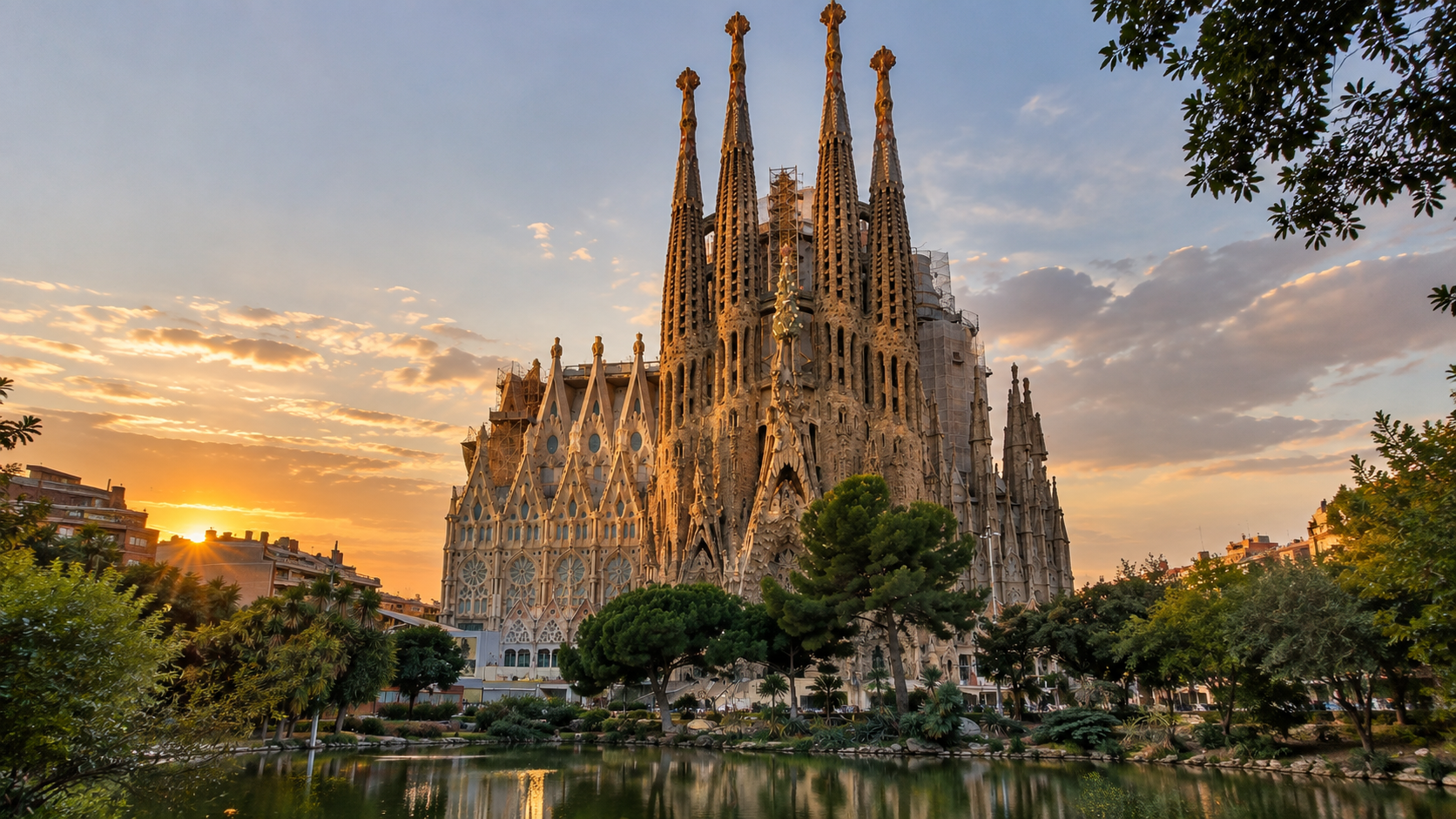
If you're paying to enter only one building during your 24 hours in Barcelona, make Sagrada Família the centerpiece of the day.
Walk around the outside before entering.
The Nativity façade rewards close inspection: instead of seeing it as one enormous decorated wall, look at individual figures, plants and sculptural details. Then compare it with the very different geometry and mood of the Passion façade.
Inside, change the way you look again.
Rather than searching immediately for individual details, stand still and look upward. The branching columns make the interior feel less like a conventional stone church and more like an enormous canopy.
Then pay attention to the light. Gaudí used stained glass and orientation to change the character of the space as daylight moves through the building.
The basilica operates timed entry, and its official ticket includes access to an audio guide through the Sagrada Família app. The standard basilica visit takes roughly an hour. Opening times vary by month and are different on Sundays, so check the official schedule before fixing the rest of your itinerary. ([Sagrada Família][3])
Sunday adjustment: Sagrada Família currently opens to visitors at 10:30 a.m. on Sundays rather than 9:00 a.m., so this itinerary works particularly well with a late-morning or midday basilica reservation. ([Sagrada Família][4])
1:30 PM — Stop for Lunch, Not Another Attraction
Twenty-four-hour itineraries often fail because every spare minute gets assigned to another landmark.
Don't do that.
Give yourself around an hour for lunch. The streets between Sagrada Família, Avinguda de Gaudí and the Eixample give you plenty of options without requiring a major detour.
This is also a useful moment to decide how much energy you have left.
If you're already tired, take the metro for the next section. If you'd rather continue walking, the distance from Sagrada Família to Casa Batlló is around 1.8–1.9 km. ([Rome2Rio][5])
2:45 PM — Walk Passeig de Gràcia and See Casa Batlló
When you reach Passeig de Gràcia, Barcelona changes character again.
After Park Güell's hillside and Sagrada Família's monumental scale, you're now looking at the architecture of a wealthy turn-of-the-century boulevard.
The most obvious stop is Casa Batlló.
Stand across the road first instead of walking immediately underneath the façade. From there, its unusual proportions are easier to read.
Look at the balconies, roofline and broken-tile surfaces. The façade seems almost alive because straight structural lines are disguised beneath curves, changing surfaces and irregular openings.
If you want to go inside, allow roughly 1 hour to 1 hour 15 minutes. Casa Batlló recommends buying tickets online in advance, and its general visit includes an audio guide. ([Casa Batlló][6])
But with only one day, you don't necessarily need another interior.
Continue a few minutes north along Passeig de Gràcia to see Casa Milà, better known as La Pedrera, from outside, then turn back toward the old city.
The one-day rule: don't go inside everything
Barcelona's major attractions can each absorb an hour or more.
Trying to visit Park Güell, Sagrada Família, Casa Batlló, La Pedrera and several museums properly in the same day changes the experience from exploration into queue management.
For a first 24-hour visit, prioritize Sagrada Família's interior, experience Park Güell outdoors, and use Barcelona's streets as the rest of your museum.
4:15 PM — Enter the Gothic Quarter
From Casa Batlló, the edge of the Gothic Quarter is roughly a 15–20-minute walk away depending on your exact destination; the broader Gothic Quarter–Casa Batlló walking distance is about 1.4 km. ([Rome2Rio][7])
This is where you should abandon the urge to walk in a straight line.
Barcelona's Gothic Quarter developed around the heart of the Roman city of Barcino, and traces of that earlier city survive among the medieval and later buildings. The area around today's Carrer del Bisbe and Carrer de la Llibreteria follows the vicinity of the Roman city's principal axes. ([Barcelona Turisme Bid][8])
Make Plaça Sant Jaume your anchor, but approach it through the smaller streets.
Then wander toward:
Barcelona Cathedral → Carrer del Bisbe → Plaça Sant Jaume → Plaça del Rei → Plaça de Sant Felip Neri
What to notice
Look where newer buildings meet fragments of much older stonework.
At street level, the Gothic Quarter can feel like a maze of shops and narrow lanes. Look upward and behind façades, however, and the historic structure becomes easier to read.
Plaça del Rei is particularly useful for this. Instead of rushing onward, stand near the center and turn slowly through 360 degrees. It gives you a much clearer sense of the scale of medieval Barcelona than walking past isolated façades.
Explore What Isn't on Your List
A self-guided day becomes more interesting when you allow yourself to investigate something you didn't plan in advance.
That might be a small church, sculpture, unusual façade or building tucked into a side street.
This is where Voyager is most useful during the route: if you don't recognize something, photograph the landmark to identify it and generate an audio explanation. You can also use nearby discovery to see what is around you rather than following another fixed tour.
The goal isn't to replace wandering with another checklist. It's to understand the things you notice while wandering.
6:15 PM — Walk Into El Born
From the Gothic Quarter, continue east toward El Born.
The transition isn't dramatic—you may barely notice that you've crossed from one historic neighborhood into another—but the atmosphere gradually changes.
Make Santa Maria del Mar your main landmark.
Before approaching the entrance, step far enough away to understand the façade as a whole. Then walk around the surrounding streets, where the scale becomes more intimate again.
This part of the itinerary deliberately has fewer mandatory stops. By early evening, leave space for whatever catches your attention.
A small square with people sitting outside may be more memorable than squeezing in one more ticketed attraction.
7:30 PM — Finish at Barceloneta and the Mediterranean
From El Born, keep walking toward the sea.
Barcelona can feel so defined by Gaudí and medieval architecture that it is easy to forget how strongly its geography is shaped by the Mediterranean.
Reaching the waterfront at the end of the day gives the itinerary a natural finish.
Walk through Barceloneta and continue toward the beach. You don't need a specific monument here. Sit down, walk along the promenade, or simply give yourself half an hour without an itinerary.
If daylight remains, this is a good time for photographs. Sunset timing changes considerably through the year, so check it for your travel date rather than planning around a fixed hour.
9:00 PM — Dinner Without a Schedule
For dinner, either stay near Barceloneta or walk back toward El Born.
Don't make your final meal another logistical project unless there's somewhere specific you already want to visit.
Barcelona is a city where a one-day itinerary benefits from some flexibility. Spend longer over dinner if you want. Return to a street you liked earlier. Have another drink. Take an evening walk.
You no longer have to catch up with a tour group.
Can You Really See Barcelona in One Day?
You can see enough of Barcelona in one day to understand its basic character, but you cannot see everything.
A well-designed 24-hour visit should give you contrasts rather than a giant list: the landscape architecture of Park Güell, the interior of Sagrada Família, the Modernisme of Passeig de Gràcia, the tight streets of the Gothic Quarter, El Born and finally the Mediterranean.
That is more useful than claiming you've "done Barcelona" because you photographed fifteen landmarks.
Do You Need a Tour Guide in Barcelona?
No. Barcelona is particularly well suited to independent exploration because many of its most interesting areas are walkable, public transport connects the major districts, and several ticketed monuments provide their own audio-guide experiences.
What you give up without a human guide is immediate historical interpretation.
You can compensate by doing a little preparation before the day, using official monument audio guides inside attractions, and using tools such as Voyager when you encounter something interesting on the street that you don't recognize.
The advantage is freedom: stop for coffee, stay longer somewhere you like, skip somewhere that doesn't interest you, and change the plan halfway through the day.
Practical Tips for Seeing Barcelona in 24 Hours
Book Park Güell and Sagrada Família first. Build the rest of the itinerary around those two timed reservations rather than trying to squeeze them into a fixed schedule.
Don't walk every transfer simply because you can. Barcelona is walkable, but a 24-hour itinerary already involves many kilometers on foot. Save your energy when necessary.
Wear comfortable shoes. Park Güell involves hills, while the historic center has long sections of stone paving.
Carry earphones and a charged phone. Sagrada Família's official visitor information specifically recommends both for its downloadable audio guide. ([Sagrada Família][9])
Check transport tickets before arriving. In 2026, Barcelona's T-casual, T-dia and other passes have different conditions, and the standard T-casual is not valid for the L9 Sud airport metro stations. ([TMB][10])
Leave one section of the day deliberately unplanned. Twenty-four hours is short, but filling every minute makes the city feel smaller rather than bigger.
If You Have Less Energy
Make one important change: skip the walk between Park Güell and Sagrada Família.
Take public transport instead, keep the Passeig de Gràcia section short, and save your walking for the Gothic Quarter and El Born, where exploring on foot matters much more.
If You Have Another Two Hours
Choose one thing rather than extending the entire route.
You could visit the interior of Casa Batlló, spend longer exploring the archaeological layers of the Gothic Quarter, linger over the waterfront, or save the extra time for another neighborhood.
If panoramic views are your priority, Montjuïc is another option—but treat it as an alternative to part of this itinerary rather than adding it on top. Montjuïc rises above the port and provides viewpoints across Barcelona, while the hill also contains museums, gardens and sites associated with the 1929 International Exhibition and the 1992 Olympics. ([Barcelona Turisme Bid][11])
The Best Way to Experience Barcelona Without a Tour Guide
The biggest advantage of exploring Barcelona independently isn't saving money.
It's being able to pay attention.
Spend ten minutes examining a façade instead of thirty seconds. Turn down a street because something catches your eye. Stop when you are tired. Skip a famous attraction if you're enjoying the neighborhood you're already in.
A guide can tell you what to look at.
A good self-guided day gives you enough context to start noticing things yourself.
Explore Barcelona with Voyager
If you don't recognize something, photograph the landmark to identify it and generate an audio explanation. You can also use nearby discovery to see what is around you rather than following another fixed tour.