Why the Jordaan feels different from the Canal Ring
The Jordaan developed during Amsterdam’s enormous expansion in the early 17th century. Unlike the grand canal houses built for wealthy merchants farther east, much of this area evolved into a densely populated neighborhood of craftspeople and working families. The City of Amsterdam notes that living conditions were often extremely cramped, while today the Jordaan is one of the city’s most sought-after central neighborhoods.
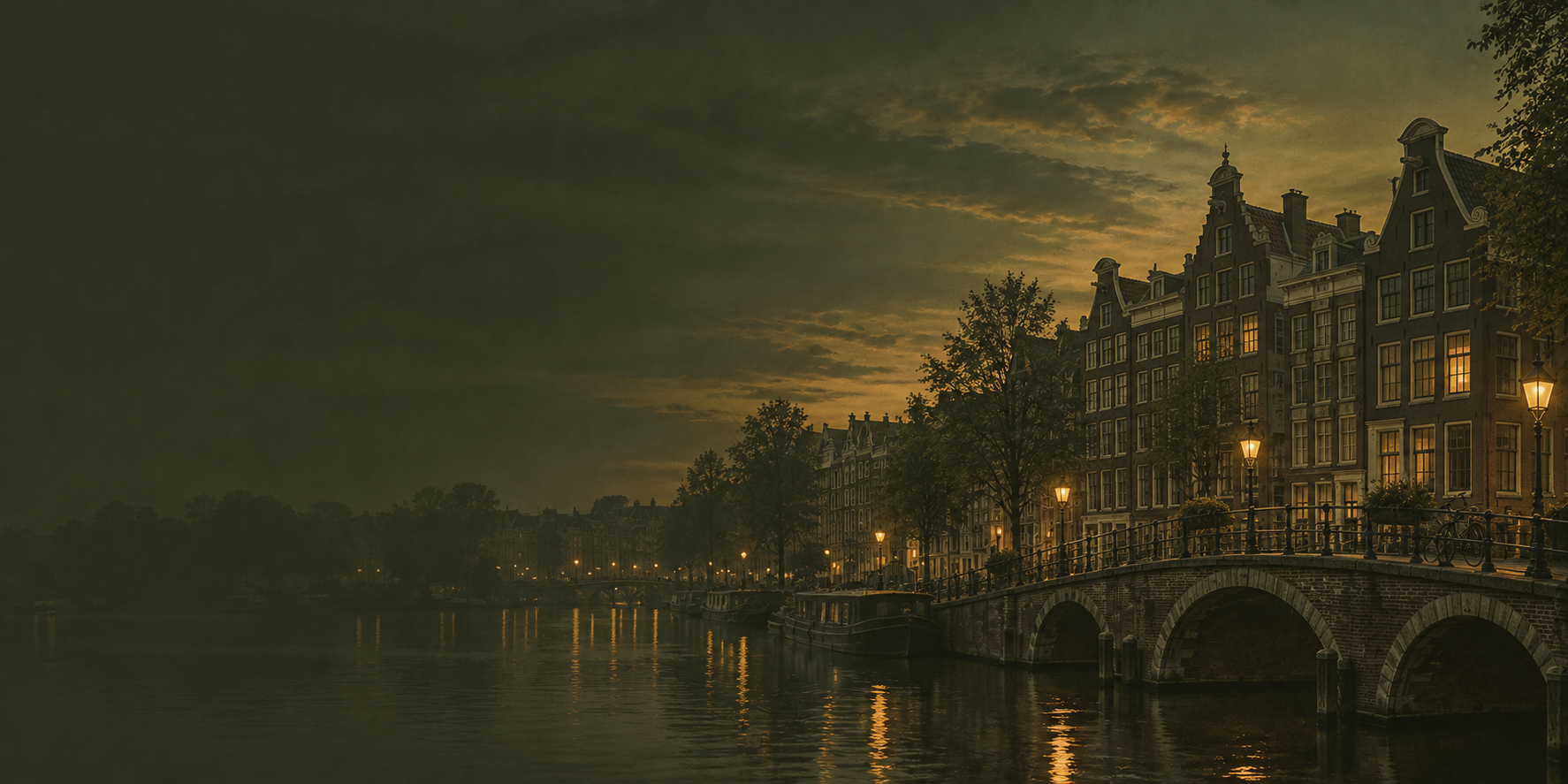
That contrast is part of what makes walking here interesting. Elegant canals such as the Bloemgracht sit only a street or two from much narrower lanes. Restored façades stand beside converted workshops. And while decades of gentrification have changed the neighborhood substantially, small cafés, galleries, specialty shops and markets still give it a character distinct from Amsterdam’s major shopping streets.
The trick is not to rush toward a checklist of attractions. In the Jordaan, the details between the attractions are often the point.
Hidden hofjes: look behind the street façades
A hofje is usually a collection of small homes arranged around a shared courtyard. Amsterdam’s hofjes historically served a social purpose, providing housing for people with limited means, often older, unmarried or widowed women. The city says Amsterdam still has dozens of them, many of which remain residential today.
The Jordaan became particularly associated with hofjes because land behind its street fronts was comparatively inexpensive during the 17th-century expansion. From the street, some entrances still look little more important than a doorway between two houses.
Sint-Andrieshof: one of Amsterdam’s earliest surviving hofjes
Start with the Sint-Andrieshof on Egelantiersgracht.
Amsterdam describes it as the city’s oldest surviving true hofje. The Begijnhof is older, but historically belongs to a different type of community. Sources date the foundation to the period around 1614–1617. It was established for Catholic women and developed around a courtyard hidden behind the canal frontage.
The entrance is easy to walk past. That is precisely what makes the experience worthwhile: one moment you are beside a canal, and a few steps later the city contracts into a much quieter shared garden.
Look for the transition itself: the narrow passage, the enclosed layout and the sudden absence of street noise. It explains the architectural idea of a hofje more effectively than simply looking at one in a photograph.
Karthuizerhof: a courtyard on much older ground
Farther north, Karthuizerhof is considerably larger.
The present complex was constructed in 1650 to a design attributed to Amsterdam city architect Daniël Stalpaert. Its four wings surrounded a large inner courtyard and originally contained roughly a hundred rooms.
But the site’s story stretches farther back. A Carthusian monastery had occupied this part of the Jordaan from the late 14th century. After its destruction, the former monastery grounds were used as a cemetery beginning in 1602 before the later housing complex was built.
When you enter, notice the scale. Compared with the Jordaan’s tight surrounding streets, the open central space feels surprisingly large.
Claes Claesz. Hofje: old Amsterdam reconstructed
Claes Claesz. Hofje tells a slightly different story.
Rather than surviving untouched from the 17th century, the complex seen today took shape during a major restoration between 1968 and 1973. It incorporated the much older Anslo’s Hofje and neighboring historic structures, using archival evidence and salvaged architectural material. The project became part of the broader effort to preserve the Jordaan at a time when extensive redevelopment was being considered.
That makes it worth noticing not only as an old courtyard, but as evidence of how Amsterdam chose to conserve its historic urban fabric.
One important rule applies to every hofje: these are not museum sets. Many remain homes. I amsterdam specifically asks visitors to respect residents and preserve the quiet atmosphere. If a gate is closed, treat it as closed rather than trying to follow someone inside.
The Jordaan’s oldest-café stories and what the dates really mean
The Jordaan is also known for its bruine cafés, or brown cafés: traditional Amsterdam pubs characterized by dark wood, compact rooms and interiors shaped by generations of use.
But claims about the city's “oldest café” can become complicated. A building may date from the 1600s without having continuously operated as a café since then, while local tradition sometimes reaches further back than surviving documentary evidence.
Two Jordaan addresses illustrate the problem particularly well.
Café ’t Papeneiland: a 1642 landmark at the canal junction
At the meeting of the Brouwersgracht and Prinsengracht stands Café ’t Papeneiland.
The building dates to 1642, and its corner position is one of the most recognizable spots in the northern Jordaan. Inside, the old woodwork, Delft tiles and traditional fittings make the interior almost as interesting as the canal view.
The history is more nuanced than the phrase “café since 1642” suggests. The café's own history identifies the building as dating from 1642 but records a taproom called De Blauwe Druif operating on the ground floor from 1896. A North Holland heritage source similarly distinguishes the old building from the later documented café operation.
There are also long-running stories about a passage connecting the building with clandestine Catholic worship nearby. Physical traces of a passage remain, but some historical accounts question the romantic version of it as a priests’ escape tunnel, so it is better treated as part of the Jordaan’s local lore rather than a completely settled fact.
Café Chris: the Jordaan’s famous 1624 claim
A few streets south is Café Chris on Bloemstraat.
The familiar story says it opened as a beer house in 1624, with builders working on the nearby Westerkerk coming here to collect their wages. I amsterdam presents it as the oldest café in the Jordaan.
There is, however, an interesting historical wrinkle. Research published by Ons Amsterdam says documentary evidence does not support the 1624 beer-house story and identifies evidence of alcohol being served at the address from 1882.
That uncertainty arguably makes the place more interesting, not less. You are seeing how Amsterdam history is made from both archives and stories repeated across generations.
Independent boutiques worth slowing down for
The Jordaan’s retail scene works best when you treat it like the hofjes: do not search only for the biggest sign.
Westerstraat, Elandsgracht, Nieuwe Leliestraat and the smaller connecting streets contain specialist stores that are easy to combine with a canal walk. If you want a much denser concentration of shops afterward, the Nine Streets are just beyond the Jordaan on the other side of Prinsengracht.
For interiors and objects: Weldaad
Beside Noordermarkt, Weldaad Authentic Interior Amsterdam mixes vintage pieces, furniture, lighting and home accessories.
Founder Mirjam Verheijke started the business in Amsterdam in 2002, with the shop moving to its current Noordermarkt setting in 2009. Its stock combines sourced vintage objects with its own collection, so this is more suited to deliberate browsing than souvenir shopping.
Even if a vintage sofa is not fitting into your carry-on luggage, the shop is a useful counterpoint to Amsterdam’s standardized city-centre retail.
For something made in the neighborhood: Almost Summer
A few streets away, Almost Summer Store Amsterdam is a locally developed clothing label and concept store.
The business traces its beginnings to 2006, when founders Efrat and Joris started printing their own T-shirts in Amsterdam. It now operates both its Nieuwe Leliestraat shop and a nearby mini-factory on Eerste Bloemdwarsstraat where designs are printed and embroidered.
For travelers who want something connected to contemporary Amsterdam rather than a standard city souvenir, that local production angle makes it a more interesting stop.
For contemporary fashion: REYÈM
On Eerste Bloemdwarsstraat, REYÈM offers a more understated fashion stop.
The brand describes its Jordaan store as the place to find its complete range as well as store-only pieces and colorways, with garments produced in Europe using recycled fabrics.
Together, shops like these explain why shopping in the Jordaan feels different from simply walking down a commercial high street. The stores are scattered among homes, cafés and old buildings, so browsing becomes part of exploring the neighborhood rather than a separate activity.
A good way to spend half a day in the Jordaan
For the most satisfying visit, start at the northern end around Brouwersgracht and Noordermarkt.
On Saturdays, Noordermarkt hosts its well-known market alongside the long Lindengracht market; on Mondays, Noordermarkt has a morning flea-market character. I amsterdam currently lists Noordermarkt hours as 09:00–13:00 on Monday and 09:00–16:00 on Saturday.
From there, wander through Karthuizersstraat before turning south toward Egelantiersgracht. Look for the hofjes rather than rushing between them, then continue through Eerste Bloemdwarsstraat and Nieuwe Leliestraat for small shops.
Finish around Bloemgracht, Bloemstraat or Elandsgracht, depending on whether you want another café, more shopping or simply a quieter canal walk.
Allow roughly three to four hours if you plan to browse shops and stop for coffee or a drink. You can physically cross the Jordaan much faster; the point is to give yourself enough time not to.
A useful way to explore without identifying everything in advance
The Jordaan is full of small visual clues: gevelstenen above doors, unusually narrow houses, old workshops, plaques, churches and architectural details that may never appear in a standard sightseeing itinerary.
If something catches your attention, Voyager can identify a landmark from your camera or show interesting places around your current location, then provide an audio explanation. That works particularly well here because you can keep wandering rather than following a compulsory sequence of stops.
When is the best time to visit the Jordaan?
For markets and street activity, Saturday morning is the obvious choice. Expect more people around Noordermarkt and the northern canals.
For quiet streets, hofjes and boutique browsing, a weekday from late morning into the afternoon offers a better balance: shops are beginning to open, while the neighborhood generally feels calmer than on a busy Saturday.
Early morning is excellent for photographing canals, but it is less useful for shopping because many small stores open later.
Can you visit the Jordaan’s hofjes?
Some hofjes can be visited quietly during the daytime, but access should never be assumed.
They remain residential spaces rather than conventional tourist attractions, and gates may be closed at particular times. Keep voices low, avoid photographing residents or directly into their windows, and never push through a closed entrance simply because a guide says a courtyard is normally accessible.
Is the Jordaan worth visiting if you have already seen Amsterdam’s canals?
Yes, because the experience is different.
Amsterdam’s grand Canal Ring is primarily about monumental façades and the wealth of the 17th-century city. The Jordaan works at a smaller scale. Courtyards, workshops, neighborhood pubs, narrow side streets and small shops tell more of the story of how ordinary residents lived around those prestigious canals.
The best moments often come when you stop looking for a landmark altogether.
Look through an open passage. Read the stone above a doorway. Turn down the narrow street beside the canal rather than automatically following the busiest route.
That is where the Jordaan becomes more than another picturesque Amsterdam neighborhood.
Explore the Jordaan with Voyager
Use Voyager to discover places around you, identify buildings and landmarks with your camera, and listen to audio explanations while you explore. Start with the places in this guide, then let the streets decide where you go next.